













How to Size an Industrial Air Filter
Most buyers pick an industrial air filter the way they pick a light bulb — by part number and hope. That works until it does not. The right air compressor filter is not the one that "fits the bracket"; it is the one whose flow, pressure drop, and physical dimensions match your actual operating condition. Size it wrong and you pay for it every hour the compressor runs: higher energy bills, shorter element life, and contamination that quietly destroys downstream tools. This guide shows you exactly how to size an industrial air filter the right way.
1What "Sizing" Actually Means
Sizing is not the same as choosing a model. It means engineering the element to your real duty cycle across four independent dimensions:
- Flow rate — the volume of compressed air (CFM or m³/min) the filter must pass at your working pressure.
- Allowable pressure drop (ΔP) — how much resistance the element is permitted to add before it costs you energy.
- Media and face velocity — the filtration surface area and the speed at which air crosses it, which set capture efficiency and dust-holding capacity.
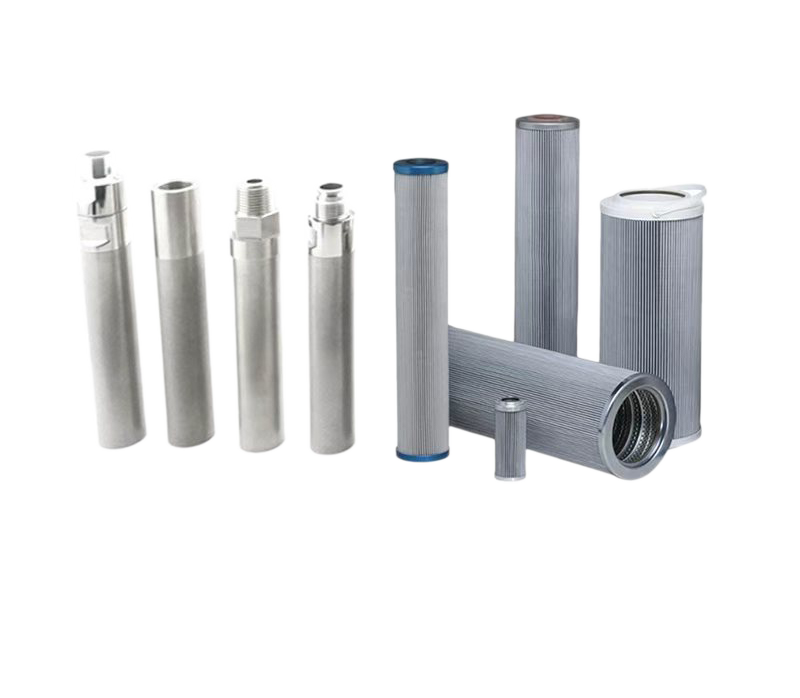
- Physical dimensions — outer diameter (OD), inner diameter (ID), height, and the flange or thread interface that locks it into the housing.
2The Real Cost of Getting It Wrong
Undersizing is the more common mistake, but oversizing hurts too:
- Undersized: face velocity climbs, ΔP spikes, the element bypasses or loads up in weeks, and fine dust reaches your air end and tools.
- Oversized: you pay more for media you do not need, the housing footprint grows, and in oil separation an oversized element can actually worsen coalescence efficiency.
3The 6-Step Sizing Method
- Determine actual flow. Use the compressor's Free Air Delivery (FAD) at your working pressure, not the nameplate maximum. Add a 15–20% safety margin for future load and dilution air.
- Set the allowable ΔP. For intake (pre) filters target ≤0.3–0.5 bar; for coalescing/oil elements ≤0.1–0.2 bar; for oil separators ≤0.3 bar. Anything higher is an energy and reliability penalty.
- Choose media and face velocity. Pleated glass-fiber media gives far more effective area than flat cellulose. Keep face velocity in the typical 0.5–2.5 m/s band; lower is better for fine filtration.
- Match physical dimensions. Confirm OD, ID, element height, and the sealing interface (threaded insert, bayonet, or bolt-down flange). A few millimetres of mismatch means a leak path.
- Confirm the seal. Specify the O-ring or end-cap gasket material — NBR for standard duty, FKM (Viton) for high temperature or synthetic lubricants.
- Cross-check the OEM number. Map your calculated spec to the original part number and ask the supplier for written confirmation that the compatible element meets the same β-ratio and ΔP envelope.
4Quick Reference: Flow vs. Element Size
Use this as a starting point for a standard pleated intake filter at ≤0.4 bar ΔP. Always verify against the manufacturer's curve.
| Flow (m³/min) | Flow (CFM) | Typical OD × Height | Recommended media |
|---|---|---|---|
| 1 – 3 | 35 – 106 | 140 × 280 mm | Pleated cellulose |
| 3 – 10 | 106 – 353 | 200 × 400 mm | Pleated glass-fiber blend |
| 10 – 25 | 353 – 883 | 320 × 600 mm | Heavy pleat, glass-fiber |
| 25 – 50 | 883 – 1766 | 450 × 800 mm (or multi) | Glass-fiber, twin element |
5Common Sizing Mistakes
- Trusting the nameplate maximum flow instead of FAD at working pressure.
- Ignoring altitude and inlet temperature — hot, thin air needs a larger element for the same mass flow.
- Mixing media types between intake and oil filtration and assuming one size fits both duties.
- Forgetting the pressure-drop budget compounds: intake + oil + separator ΔP all stack onto the same compressor motor.
6Pre-Install Sizing Checklist
- FAD at working pressure recorded, with 15–20% margin applied
- ΔP budget allocated per filter stage
- Face velocity within 0.5–2.5 m/s for the chosen media
- OD, ID, height, and flange/thread verified against housing
- Seal material matched to lubricant and temperature
- OEM part number cross-referenced and confirmed in writing
- Spare on hand so change-out happens on schedule, not on failure
7Compatible With Major Brands
A properly sized air compressor filter can be sourced as a brand-compatible element for most rotary screw platforms — without paying the OEM premium.
8Frequently Asked Questions
Can I just use a bigger filter to be safe?
Not always. A larger intake filter is usually fine, but an oversized oil separator can reduce coalescence efficiency and raise carryover. Size each stage to its own ΔP budget rather than blanket "go big".
Does inlet temperature change the size I need?
Yes. Hot, less-dense air carries the same mass flow through a larger volume, so higher inlet temperature or altitude calls for a larger element to keep face velocity (and ΔP) in range.
How do I read a filter's β-ratio when sizing?
βx is the ratio of particles upstream to downstream at size x (microns). β₅=200 means 200 particles ≥5 µm upstream for every 1 downstream — 99.5% capture. Match β to your ISO 8573-1 purity class, then size the media to hold that efficiency at your flow.
What if my compressor is between two standard sizes?
Round up to the next size and confirm the housing will accept it. If space is tight, choose higher-efficiency pleated media at the smaller envelope rather than forcing an oversized element that will not seal.