











How to Troubleshoot Oil Separator Problems in Screw Compressors
Your screw air compressor has been running normally for months. Suddenly, you notice oil stains in the compressed air pipeline, the oil level in the separator tank keeps dropping, and your maintenance team has to refill lubricant more frequently. Is it simply an oil leak? Not necessarily. A faulty or inefficient oil separator could be the real reason. When it stops working efficiently, the consequences go far beyond increased oil consumption: more oil carryover, higher maintenance costs, reduced operating efficiency, and potentially costly equipment damage.
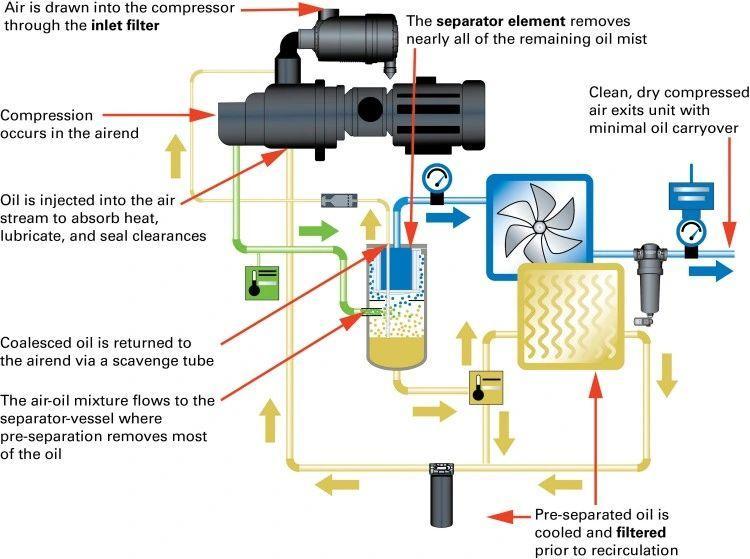
Air and oil flow in an oil-injected screw compressor: oil is injected into the airend to absorb heat, lubricate, and seal clearances; it is pre-separated in the separator vessel, coalesced by the separator element, and returned via the scavenge tube.
1. Common Oil Separator Problems and Their Symptoms
Different symptoms can point to different causes. Check which of the following four problems matches your compressor before starting maintenance.
1.1 Excessive Oil Carryover
Symptoms: visible oil in the compressed air pipeline; oil mist downstream of the compressor; excessive lubricant consumption; oil contamination in air receivers or pneumatic equipment.
Possible causes: the oil separator element is clogged, damaged, or deteriorated; the element is incorrectly installed; the oil return line is blocked or damaged; unsuitable operating conditions; the oil level in the separator tank is too high; the element is unsuitable for the compressor model or operating requirements.
How to troubleshoot: check whether the element has reached its recommended service life; inspect it for physical damage, deformation, or poor sealing; check the oil return line, including the pickup tube and orifice, for blockages; verify that the oil level meets the manufacturer's specifications; confirm that the separator is compatible with the compressor model and technical requirements.
1.2 High Pressure Drop Across the Oil Separator
Symptoms: abnormally high differential pressure; increased energy consumption; reduced system efficiency; compressor alarms or shutdowns due to high differential pressure.
Possible causes: the element is clogged; the filter media has become contaminated; the compressor is operating outside its designed conditions; the element is undersized or incorrectly selected; the lubricating oil has deteriorated or become contaminated.
How to troubleshoot: check the differential pressure gauge or sensor; compare the reading with the manufacturer's recommended threshold; inspect the element for contamination or blockage; check the oil condition; replace the element if the differential pressure exceeds the specified limit.
AIRPULL Tip: a high-quality oil separator should provide efficient oil separation while maintaining a low initial pressure drop. Selecting the right filtration media and structural design helps support stable compressor performance.
1.3 Frequent Oil Separator Element Failure
Symptoms: the element needs to be replaced frequently; oil carryover increases shortly after installation; the element becomes deformed or damaged; differential pressure rises much faster than expected.
Possible causes: incorrect installation or improper sealing; excessive airflow or unsuitable operating conditions; poor-quality filtration media; incorrect element dimensions or structural design; contamination in the compressed air and lubrication system.
How to troubleshoot: verify the element's dimensions and compatibility; inspect the sealing gasket and installation position; check whether the operating pressure and airflow are within specifications; review the element's service history; investigate whether the problem occurs with a specific batch or supplier. Frequent failures are not always a sign of poor product quality.
1.4 Oil Leaks Around the Separator Housing
Symptoms: oil leakage around the separator cover; oil stains near the separator tank; lubricant consumption increases without obvious downstream oil carryover.
Possible causes: damaged or aged sealing gaskets; loose housing bolts; incorrect gasket dimensions; improper installation; cracks or damage in the separator housing.
How to troubleshoot: stop the compressor and follow the manufacturer's safety and depressurization procedures; inspect the housing and sealing surfaces; check the gasket for deformation, aging, or damage; verify that all components are correctly positioned; replace damaged seals and tighten fasteners to specification.
2. Step-by-Step Guide to Troubleshooting Oil Separator Problems
When an oil separator problem occurs, replacing the element immediately may not solve the underlying issue. A systematic inspection helps prevent unnecessary maintenance costs.
- Identify the main symptom. Determine whether the problem is excessive oil carryover, high differential pressure, frequent element failure, or oil leakage, and record operating conditions and alarm information.
- Check the operating parameters. Review operating pressure, airflow and load conditions, separator differential pressure, lubricant level and condition, and operating temperature. Compare the readings with the manufacturer's specifications.
- Inspect the oil return system. A blocked return line can cause oil accumulation inside the separator and increase oil carryover. Check the pickup tube, return line, and orifice for blockages or damage.
- Inspect the oil separator element. Check for clogged or contaminated media, damaged filter layers, deformation, poor sealing, and incorrect dimensions. If the element is damaged or has exceeded its service life, fit a suitable, compatible element.
- Verify compatibility before you buy. Confirm the OEM part number or cross-reference number, overall dimensions, connection and sealing structure, filtration performance requirements, and operating pressure and airflow requirements.
Still Can't Pinpoint the Problem?
Send us your compressor brand, model, or a photo of the current separator. Our engineers will help you identify a compatible oil separator and suggest the right next step — no guesswork required.
Get a Free Compatibility Check3. When Should You Replace a Screw Compressor Oil Separator?
There is no universal service interval. The actual service life depends on compressor design, operating conditions, lubricant quality, ambient environment, and maintenance practices. The following conditions indicate that an inspection or an element change may be necessary.
| Warning Sign | Recommended Action |
|---|---|
| Differential pressure exceeds the specified limit | Inspect and replace if required |
| Persistent oil carryover | Check the separator and oil return system |
| Damaged or deformed element | Replace immediately |
| Element reaches its recommended service interval | Follow the manufacturer's maintenance schedule |
| Repeated oil separator failures | Investigate compatibility and operating conditions |
Important: always follow the compressor manufacturer's maintenance instructions. Before opening the separator housing, shut down the compressor, isolate it, allow it to cool, and fully release internal pressure.
4. How to Choose the Right Compatible Oil Separator
Replacing a faulty element is only part of the solution. Choosing an element that is fully compatible with your compressor is equally important. For distributors, compressor service companies, and industrial buyers, the following factors deserve attention.
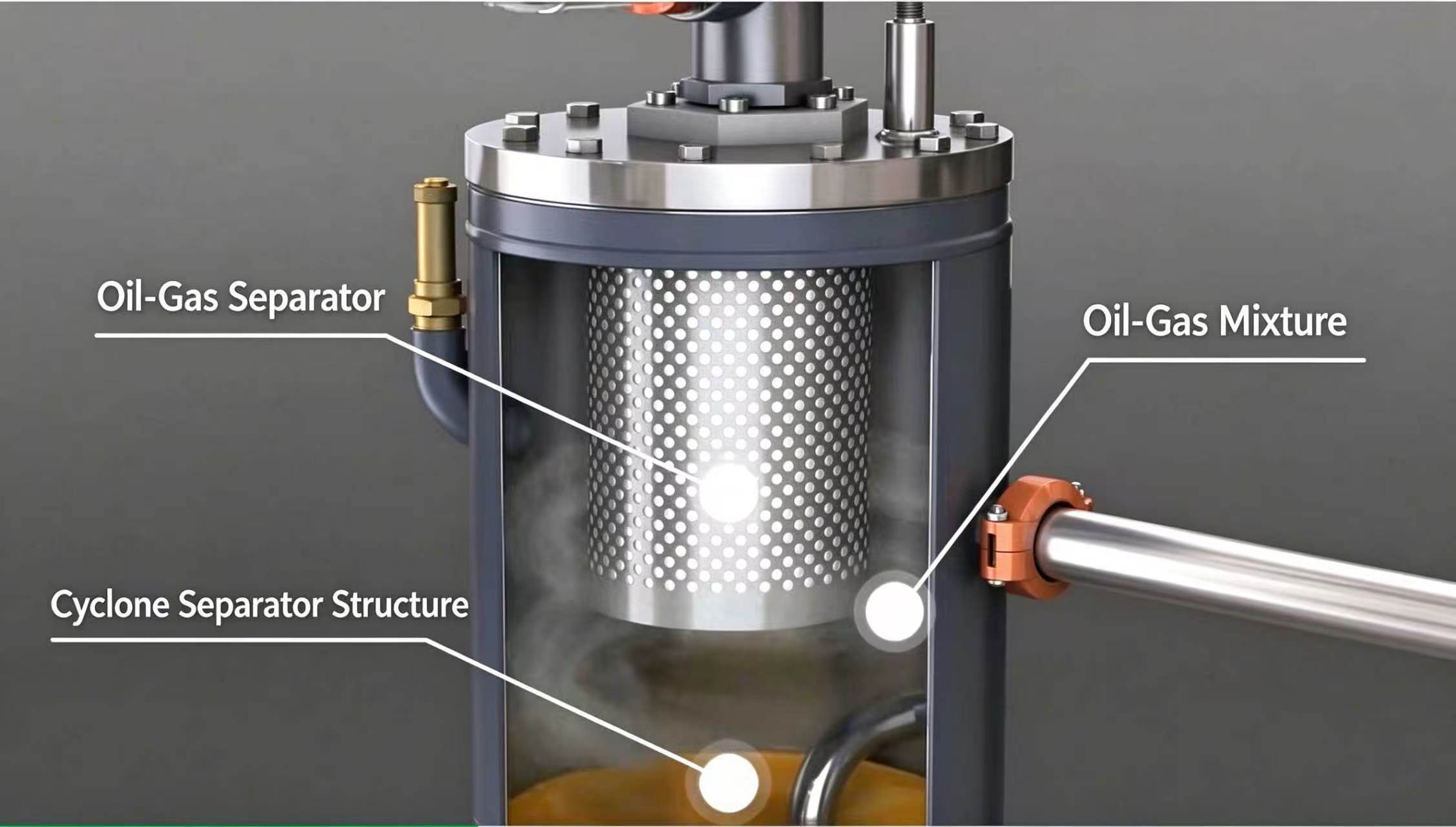
Inside an oil-gas separator: the cyclone pre-separation structure, the oil-gas mixture inlet, and the coalescing separator element that removes the remaining oil mist.
- Accurate compatibility: the element should match the compressor's original dimensions, connection structure, and performance requirements.
- Reliable filtration performance: high-quality glass fiber media and an optimized separation structure help achieve efficient oil separation and low residual oil content.
- Stable pressure drop: a properly designed oil separator helps maintain stable airflow and reduce unnecessary energy consumption.
- Consistent product quality: reliable materials, controlled manufacturing processes, and quality inspections ensure consistent performance.
- Reliable supply and support: part-number cross-referencing, technical documentation, customized solutions, and responsive delivery.
AIRPULL: Your Screw Compressor Oil Separator Manufacturer
Since 1996, AIRPULL has focused on industrial filtration and compressed air filtration solutions, providing compatible filters for a wide range of screw compressor brands and applications.
- Extensive product range: oil separators, air filters, and oil filters for various compressor models
- OEM part number cross-reference: helping customers identify suitable compatible elements
- Professional manufacturing: advanced production facilities and strict quality control processes
- Customized solutions: technical support for special dimensions, operating conditions, and filtration requirements
- Reliable supply: stocked products and flexible manufacturing arrangements to support delivery needs
Whether you are a compressor distributor, maintenance service provider, or industrial equipment buyer, AIRPULL is ready to support your filtration requirements.
Don't Let a Small Oil Separator Problem Become a Costly Downtime Event
Send us your compressor brand, OEM part number, or a photo of your existing oil separator. Our team will help you identify a compatible element and provide professional filtration support.
Contact AIRPULL Today